

 E-Paper


Nuke bill clears LS as Oppn wants House panel scrutiny
The bill proposes the grant of licences to private companies to operate nuclear power plants
The Lok Sabha on Wednesday passed The Sustainable Harnessing and Advancement of Nuclear Energy for Transforming India Bill, 2025 or the SHANTI bill via a voice vote after the Opposition, which demanded that the bill be referred to a parliamentary panel, walked out in protest.

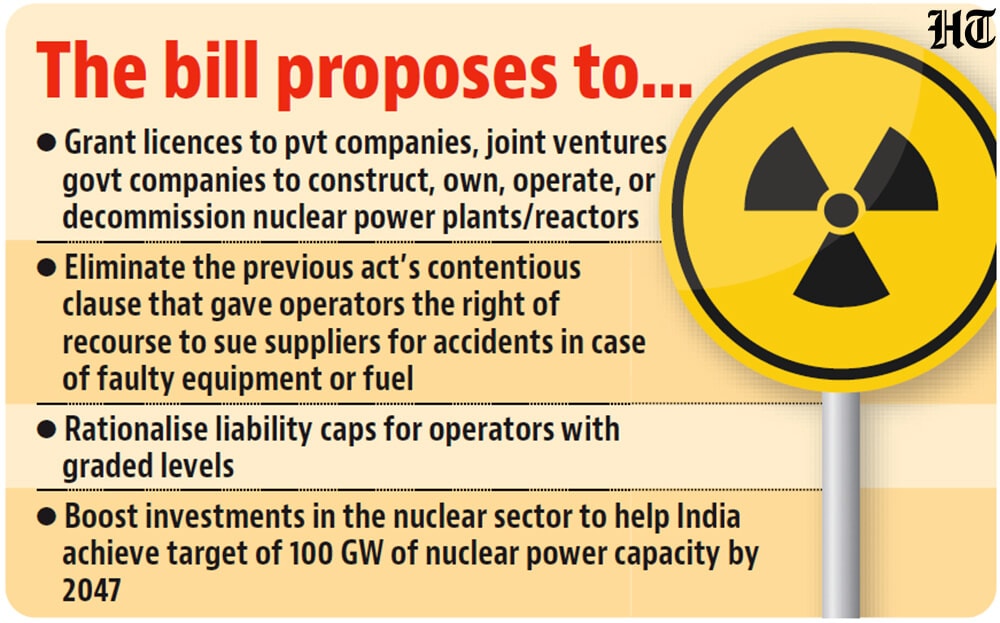
The bill proposes the grant of licences to private companies to operate nuclear power plants, the removal of an existing contentious liability clause for suppliers of fuel and technology, as well as the rationalisation of the levels of payouts by operators in case of accidents. It aims to boost investments in the nuclear power sector to help India achieve its ambitious target of 100 GW of nuclear power capacity by 2047.
Union minister for state for atomic energy Jitendra Singh, who had introduced the bill earlier in the week, defended the liability provisions.
“The suppliers’ responsibility will lie with the operator, who is free to have an agreement (with the supplier). Earlier, the word suppliers had a board definition and as a result, everybody was hesitant to come forward. There was a silent phobia. In the last ten years, we lost out on opportunities,” he told the Lok Sabha in his reply to the debate.
Singh argued that most of the security provisions have been retained from the Jawaharlal Nehru-era’s 1962 law on atomic energy.
The bill proposes to repeal the Atomic Energy Act 1962 and the Civil Liability for Nuclear Damage Act (CLND Act) 2010. It removes a clause in the CLND Act, that gave the operator of a nuclear power plant the right of recourse in case of damage that has “resulted as a consequence of an act of supplier or his employee, which includes supply of equipment or material with patent or latent defects or sub-standard services.”
Global suppliers of components and fuel had been concerned about the law allegedly allowing action against suppliers in case of any damage.
The government has now proposed to completely do away with this clause in a bid to allay their concerns. This section has been a major deterrent for several US companies.
“In the 2010 bill, there was capping of liability. Now, we have rationalised it and done different grading. Capping is for the operator but full compensation will be given because the next stage will be the Nuclear Liability Fund which would be established by the Union government. Further compensation will be available through that course,” the minister said.
Even as many Opposition lawmakers questioned the need for private investments in the atomic energy sector, Singh argued that private investments were required to reach the target of 100 GW of clean energy by 2047.
“In 2014, the department of atomic energy’s budget was ₹13,879 crore. Now, it stands at ₹37,483 crore. If we have kept a target of 100 GW by 2047, we have moved close to our target of green energy sources. If we have to follow a global role for ourselves, we have to follow global strategies. We opened up space. Now we have 300-400 space start ups,” he said.
“Nuclear energy upscaling is being done to help the health sector, agriculture sector. We have also opened up research to the private sector. If we have to reach our target, currently we have 8-9 GW. We have 25 reactors, out of which, one is not fully functional. Our current contribution (of atomic energy) is just 3%. Our renewable energy will go up but it will not be able to serve all purposes. In 2015, we started joint ventures. We became prisoners of our limited resources. Some embargoes could be done away with,” he said.
Congress leader Manish Tewari, who initiated the debate, said the bill envisages “privatising profit and socialising liability.”
As Singh said that the idea of the bill was to bring an enabling law without compromising security concerns, Tewari said, “I did not find a single word about the supplier’s liability. There will be a greater presence of foreign suppliers if the nuclear sector is opened up. How is removing the supplier’s liability clause going to help India?”
Tewari pointed out that the bill makes the Atomic Energy Regulatory Board (AERB) a statutory body but didn’t give it autonomy as the government can give orders to AERB. Tewari argued that the Manmohan Singh government ended the nuclear apartheid against India when it signed the 123 Agreement or the Indo-US nuclear treaty. “But the BJP had opposed it and even brought a non-confidence motion against the government. You tried to derail India’s nuclear programme due to political reasons,” Tewari said.
Congress MP Shashi Tharoor dubbed the bill as a “dangerous leap into privatised nuclear expansion” and pointed out that the bill didn’t allow civilians, non-governmental organisations or even state governments to sue an operator in the case of an accident. “Those who would be worst affected in case of an accident, can’t even lodge a complaint.”
Tharoor quipped that he was not sure if it was a “nuclear bill or an unclear bill.”
“We cannot allow the pursuit of capital to override the non-negotiable requirements of public safety, environmental protection and victim justice. The name SHANTI means peace and sustainability. Let us ensure that this name is not a cruel irony in the aftermath of a preventable disaster. The promise of transforming India ought not to conflate the risk of scarring India,” the Thiruvananthapuram MP said.
“The full life cycle of nuclear fuel from mining to waste disposal is neither clean nor sustainable. We must be honest with the people of India about what we are asking them to accept. Section 3(1)(c) and (e) provide that any other company or any person expressly permitted by the central government is eligible to apply for a licence to set up and run nuclear facilities,” he added.
Shiv Sena (UBT) leader Arvind Sawant questioned how the government would ensure that a private company provided the same level of safety as the public sector. He urged that the bill be sent to a joint parliamentary committee for comprehensive discussion and then brought back with a consensus. Urging the government to send the bill to a select committee, Trinamool Congress member Saugata Roy said nuclear energy was a “risky proposition” and the government has put maximum liability in case of an accident at just 300 million special drawing rights — an international special asset created by the International Monetary Fund (IMF).
DMK member Arun Nehru termed the name of the bill, SHANTI, as “oxymoron” as the nuclear energy has nothing to do with ‘shanti’ (peace). He demanded that the bill be sent to a joint parliamentary committee. Referring to nuclear accidents, he said the government must take extreme precautions while setting up nuclear power stations.
The bill permits any company or joint venture to construct, own, operate, or decommission a nuclear power plant or reactor within the country after receiving a licence that requires a safety authorisation on radiation exposure. The bill says “any department of the Government of India or any institution or authority or corporation established or owned or controlled by such government, any government company, any other company, a joint venture among any of the aforesaid; or any other person expressly permitted by the central government, by notification, to set up such facilities or undertake such activities,” will be eligible to apply for a licence .
However, enrichment of nuclear fuel and management of spent fuel as well as the production of heavy water will remain the preserve of the central government or entities owned by it.
So far only public sector companies could operate nuclear power plants, though joint ventures were allowed. Indian conglomerates, including the Adani Group, Larsen & Toubro (L&T), and Tata Power Ltd, have previously publicly shown interest in entering the nuclear power generation space.

