

 E-Paper


‘Total failure’: Supreme Court instructs CAQM to redo bad air plan
The court noted that air pollution in Delhi and the National Capital Region (NCR) has become a predictable annual phenomenon, particularly during winter.
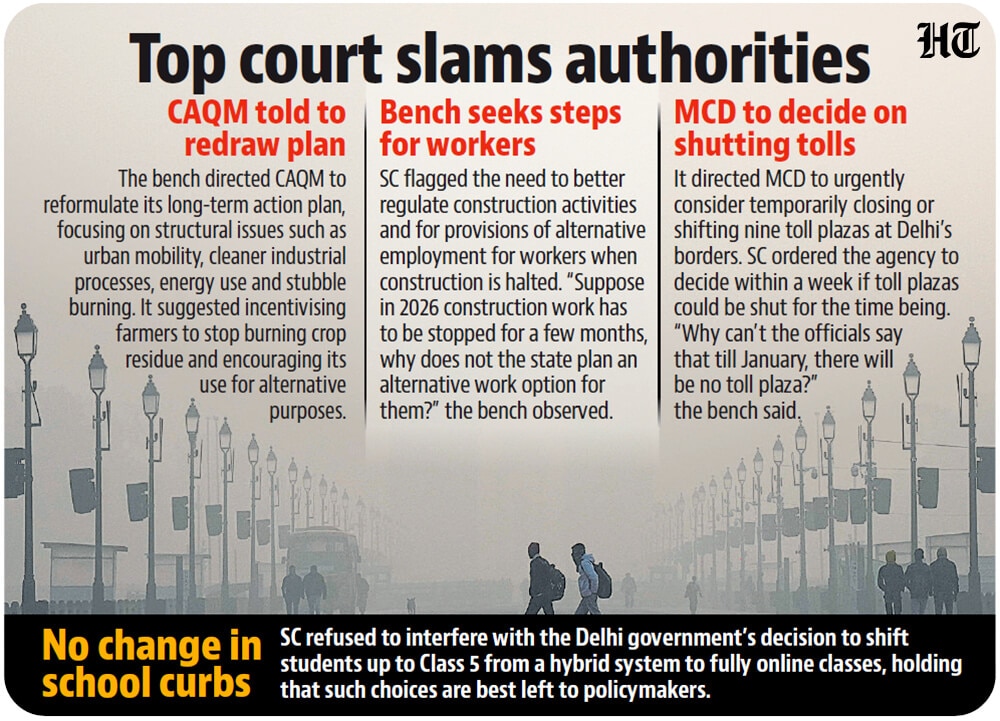
Terming measures taken so far to curb air pollution in Delhi-NCR a “total failure”, the Supreme Court on Wednesday sent the Commission for Air Quality Management (CAQM) back to the drawing board, calling for a comprehensive long-term strategy to address the annual crisis, specifically asking it to focus on issues such as urban mobility, cleaner industrial processes, energy use and stubble burning.

A bench led by Chief Justice of India Surya Kant, along with justices Joymalya Bagchi and Vipul M Pancholi, underlined that ad hoc and short-term responses cannot deliver any meaningful reduction in pollution levels.
“Whatever efforts were taken so far, they have failed. We have to think of long term,” the bench remarked, stating that the current approach had exhausted its utility.
The court noted that air pollution in Delhi and the National Capital Region (NCR) has become a predictable annual phenomenon, particularly during winter, requiring structural planning rather than reactive firefighting. It emphasised that any sustainable solution must be implemented in a phased manner and backed by coordinated action across states.
Hearing a clutch of petitions challenging measures such as closing schools or hybrid learning to protect children, the bench declined to interfere. The court observed that such steps were temporary measures to mitigate immediate health risks but cautioned that they could not substitute for long-term solutions.
Also Read | As Delhi anti-pollution rules kick in, here's who is exempt from the latest curbs
In a detailed order, the Supreme Court directed the CAQM to reformulate its long-term action plan, focusing on structural issues such as urban mobility, cleaner industrial processes, energy use and stubble burning. It suggested incentivising farmers to stop burning crop residue and encouraging its use for alternative purposes.
The court flagged the need for better regulation of construction activities and the provision of alternative employment for workers when construction is halted. It asked authorities to examine pollution generated from household activities and identify areas to increase green cover.
Improving public transport, strengthening citizen awareness programmes and encouraging voluntary behavioural changes were highlighted as priority areas. The bench allowed the CAQM to identify other relevant sectors requiring intervention.
Stressing that pollution control cannot succeed in silos, the court said a coordinated approach involving Delhi, Uttar Pradesh, Haryana and Rajasthan was essential. It asked CAQM to consider constituting a single regulatory and administrative body for the entire Delhi-NCR to ensure accountability.
The Supreme Court has been monitoring air pollution in Delhi-NCR for nearly four decades, beginning with a public interest litigation filed in 1985 by environmentalist MC Mehta. Successive benches have passed orders directing the conversion of Delhi’s public transport fleet to compressed natural gas (CNG), regulating industrial emissions and restricting polluting vehicles. These interventions led to the conferral of statutory powers on the CAQM.
The bench also addressed concerns regarding construction workers affected by stoppages under the Graded Response Action Plan (GRAP). It cautioned that welfare measures must genuinely reach workers and not become tools for exploitation. The labour welfare department must ensure benefits percolate to the marginalised rather than remaining mere accounting entries linked to Aadhaar, the court said.
Pointing to the recurring nature of bans, the court asked states to frame a policy providing alternative employment during prolonged suspensions. “Suppose in 2026 construction work has to be stopped for a few months, why does not the state plan an alternative work option for them?” the bench observed.
Signalling sustained scrutiny, the Supreme Court said it would hear the matter at least twice a month. The case is listed for January 6, when the CAQM is expected to place its revised roadmap on record.


