

 E-Paper


Delhi Ridge gets new statutory board to oversee protection, permissions
The Ridge has long been under pressure from real estate interests, construction activity, and government projects.
The Union environment ministry has reconstituted the Delhi Ridge Management Board (DRMB) with statutory powers, as directed by the Supreme Court in November, in a move that will create one entity responsible for issuing permissions related to use of the Delhi Ridge, and monitoring and acting against encroachments and other violations that threaten the Capital’s green lung.

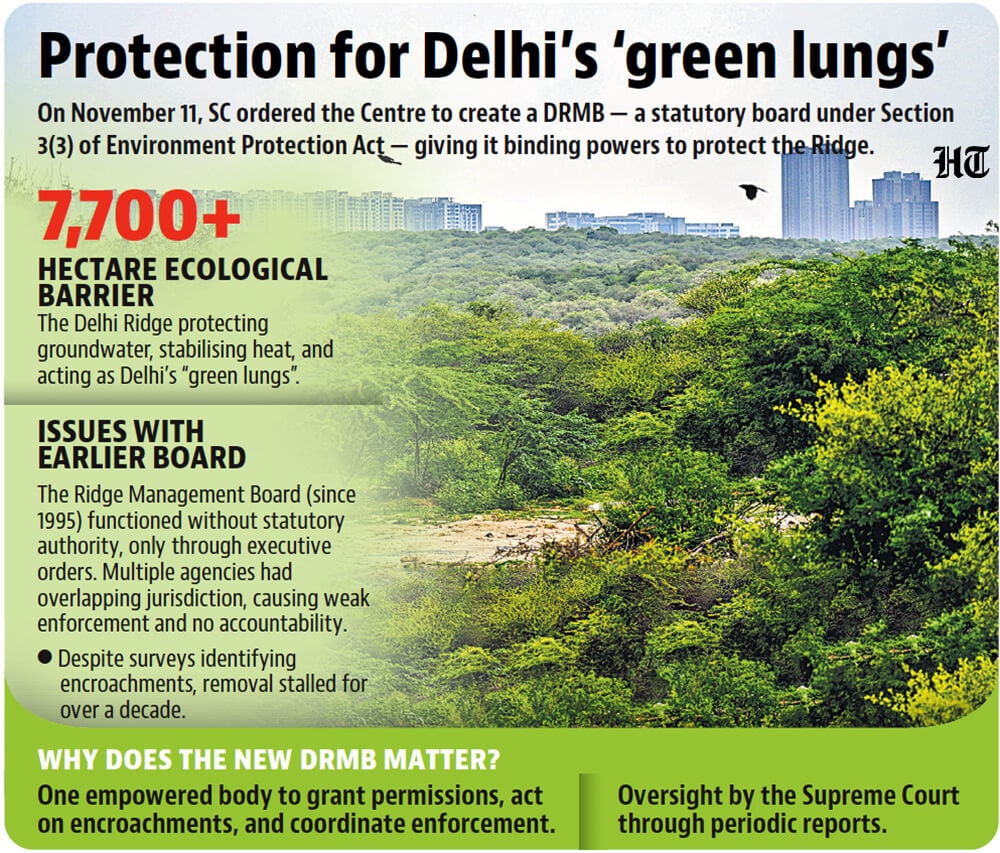
It replaces the existing Ridge Management Board, which was constituted in 1995 and reconstituted several times, albeit without statutory powers. The December 1 notification was issued under powers conferred by sub-section (3) of Section 3 of the Environment (Protection) Act, 1986. This section empowers the Central government to establish specific authorities through official gazette orders to exercise and perform certain powers and functions, including issuing directions, for protecting the environment.
On November 11, a bench of then Chief Justice of India BR Gavai and justice K Vinod Chandran asked the Union ministry of environment, forests and climate change (MoEFCC) “to constitute DRMB by issuing notification under Section 3(3) of the EP Act,” so that it has teeth to act. In that order, the court said that DRMB needs statutory backing, and pointed out that while there were several entities looking after the Ridge, the overlapping jurisdictions made all of them sub-optimal. The court also said the DRMB thus created would focus on the removal of encroachments and also oversee afforestation.
The 2021 Master Plan for Delhi identifies the Delhi Ridge as an area measuring 7,777 hectares of land, divided into four zones: Northern, Central, South Central (Mehrauli), and Southern. The Ridge – often described as the city’s “green lungs” – has long been under pressure from real estate interests, construction activity, and government projects.
“We are, however, of the view that without proper identification or preservation of the Ridge, the integrity of the entire ecology would be compromised. The Ridge acts as the green lungs of the city, especially in the present conditions of increased pollution. We, therefore, find that the DRMB needs to actively work towards protecting and preserving the Delhi Ridge after its due identification,” the SC order states.
Experts are not convinced the creation of DRMB would have the desired outcome. They said it may again start a process of issuance of various orders but not ensure immediate remediation for the Ridge which already has a lot of encroachments. “The functions of the board are laudable. Question would be the exercise of its powers and how would it direct removal of unauthorised constructions and encroachments except a general provision in clause H which states that all authorities in the territory of the NCT of Delhi shall act in aid of the discharge of the duties of the board. In the southern ridge, all encroachments after three extensive surveys have been identified and maps filed in NGT, that too after dilly dallying for over a decade. The only issue that remains is their removal,” said Raj Panjwani, senior advocate.
According to the MoEFCC notification, the DRMB will have 13 members, be headed by the chief secretary of the Delhi government, and include among its members: a representative of the Director General of Forests and special secretary, MoEFCC, not below the rank of inspector general of forests; a representative of the ministry of housing and urban affairs, not below the rank of joint secretary; a representative of the Central Empowered Committee (CEC) appointed by the SC; and two civil society members to be appointed by the Delhi government.
MoEFCC had initially, in the SC, opposed granting statutory status to the DRMB, expressing apprehension that if the Centre issues a notification, there would be an overlap with other authorities.
The member of the Central Empowered Committee designated to DRMB shall report to the Supreme Court every three months regarding the proper functioning of the DRMB and its standing committee.
“The newly constituted DRMB… represents a significant strengthening of the governance framework for protection of the Delhi Ridge and the Morphological Ridge. The Supreme Court, in its November 11 judgment highlighted persistent deficiencies in earlier boards, including absence of statutory authority, overlapping committees, weak enforcement, and inadequate inter-agency coordination… The most critical improvement is the statutory backing now provided under the EP Act. Earlier DRMBs operated only through executive orders, limiting enforceability and accountability. The new Board’s statutory status ensures binding decision-making authority and oversight under the Hon’ble Supreme Court, resolving long-standing jurisdictional gaps,” MoEFCC said in response to HT’s queries on how the new board will help protect the Ridge.
According to SC’s order, though the total identified area of Ridge was 7,784 hectares, the final notification under Section 20 of the Forest Act has been issued only in respect of 103.48 hectares of land. “DRMB has been acting without any statutory authority. The original notification dated October 6, 1995 was issued only pursuant to this court’s order dated September 29, 1995 in MC Mehta and that too without any statutory backing for the board. We are, however, of the considered view that without statutory backing, it will not be possible for the board to function effectively.”
“The Ridge forests are among the city’s most vital geological and ecological assets. They replenish groundwater, soften the dust-bowl effect, moderate the urban heat-island, and provide precious habitat for wildlife—leopard, jackals, porcupines, nilgai and a remarkable diversity of birds, reptiles and insects. They are also Delhi’s green lungs, absorbing pollutants and carbon dioxide in one of the world’s most polluted urban regions,” said Vijay Dhasmana, curator of the Aravalli Biodiversity Park, Gurugram.
“I hope the new Ridge Management Board takes decisive action to safeguard this landscape: remove encroachments, halt any diversion or land-use change, and reconnect the fragmented stretches of the Ridge so wildlife can move freely once again. My wish is to see every degraded patch of the Ridge ecologically restored scientifically and systematically, allowing this ancient forest to heal and breathe life back into the city,” he added.


