

 E-Paper


15% Tamil Nadu voters could be deleted in post-SIR list
The draft electoral rolls after the first phase of the SIR was published on Friday, just months ahead of the 2026 assembly elections
Around 9.7 million names might be dropped from the electoral rolls of Tamil Nadu after the special intensive revision, data from the election commission showed on Friday, marking the highest percentage of potential deletions in the controversial exercise among major states.

The draft electoral rolls after the first phase of the SIR was published on Friday, just months ahead of the 2026 assembly elections. Of the 64.1 million electors in Tamil Nadu as on October 27, around 9.7 million or 15.2% could be deleted.
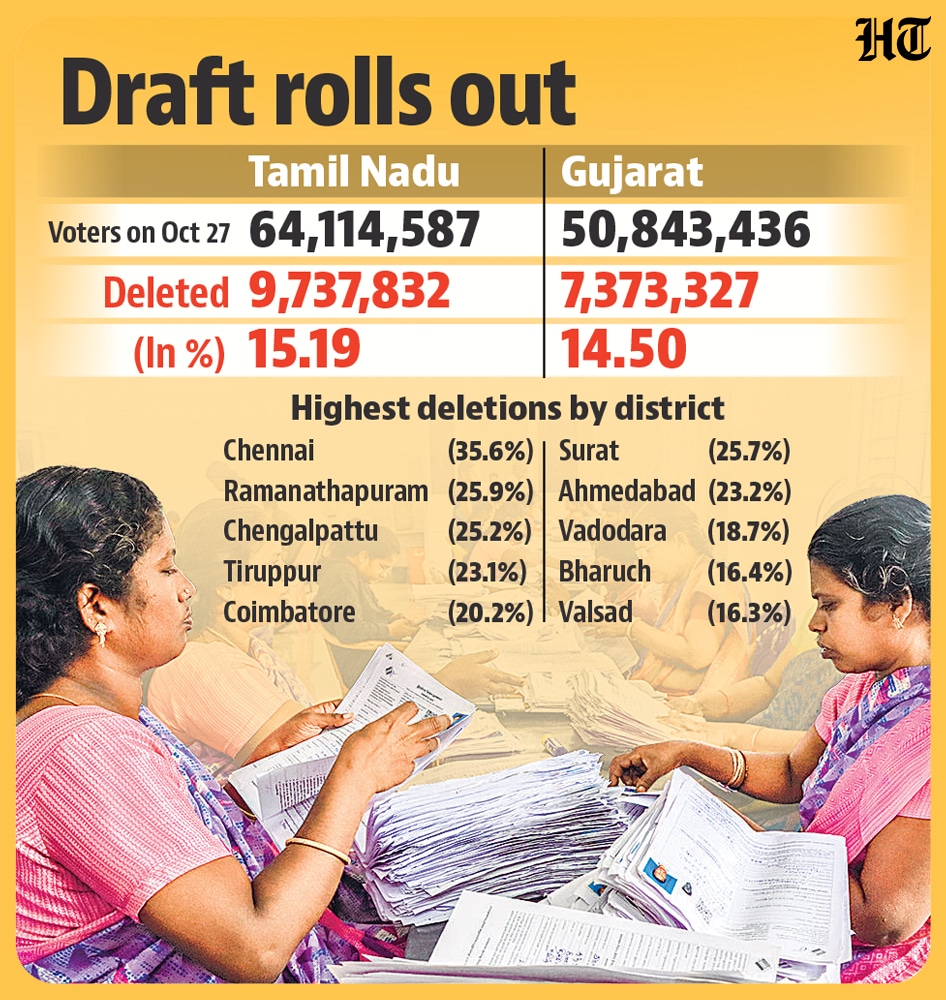
This was because either booth level officers (BLOs) could not reach them or the electors did not give their enumeration forms back. Of the 9.7 million, 2.7 million were presumed dead, 6.6 million had shifted or were found absent, and 0.4 million were found to be enrolled in multiple places, the EC data added.
The final rolls will be published in February 2026. The assembly elections are scheduled next summer, alongside Kerala, West Bengal, Puducherry and Assam.
A district-wise analysis showed that urban centres were more likely to have seen potential deletions, with the highest percentage of such names from state capital Chennai, where roughly 35.6% of the four million strong electorate is in danger of being removed from the rolls.
Genuine electors can still be added back in the electoral rolls during the claims and objections period from December 19 up to January 18, said Tamil Nadu’s chief election officer Archana Patnaik. “We will also be conducting special camps every weekend to help those whose names have not been included,” Patnaik.
“Not one name can be dropped without following due procedure. There are about 12,000 odd people who did not return their enumeration forms.”
The five districts with the highest potential deletions were Chennai, Ramanthapuram, Chengalpattu, Tiruppur, and Coimbatore. The proportion of deletions in these districts stood at 35.6%, 25.9%, 25.2%, 23.1%, and 20.2%, respectively. Chennai, Chengalpattu’s parent district in the census (Kancheepuram), Tiruppur, and Coimbatore had an urban population share of over 60% in the 2011 census, among the highest in the largely urban state.
In absolute numbers also, Chennai led the pack in the number of potential deletions, followed by adjoining district Chengalpattu (701,000), the western districts of Coimbatore (650,000) and Tiruppur (560,000), and Erode (320,000).
In chief minister and Dravida Munnetra Kazhagam chief MK Stalin’s constituency in Kolathur in Chennai, about 109,000 names might be removed, data showed.
The lowest possible deletions were seen in the Ariyalur, Madurai, Dharmapuri, Kallakurichi, and Virudhunagar districts, which saw names of 4.6%, 5.1%, 6.3%, 7.3%, 7.6% electors, respectively, on the chopping block. Ariyaulur, Dharmapuri, Kallakurichi’s parent district in the census (Viluppuram) were among the least urban districts in the 2011 census.
To be sure, some of these district trends must be read with caution. The total number of electors dead, absent/shifted, or enrolled at multiple places does not match the total number of deleted electors in Ramanathapuram, Theni, Virudhunagar, and Madurai. The total is less than the sum of the three categories in Virudhunagar and Madurai and more than the sum of the three in the other two districts.
All India Anna Dravida Munnetra Kazhagam (AIADMK) general secretary Edappadi Palaniswami, who supports SIR, attributed the deleted names to duplication.
“Most of these were fake votes, which proves the reason why the AIADMK has been saying that SIR is needed since the beginning. The DMK, which had hoped to seize power by using fake votes and distorting democratic values, is preparing to stage various dramas in anger and anxiety over the shattered dream of coming to power,” he said.
The DMK has been protesting against the SIR and moved the Supreme Court against the exercise, arguing that it was being done hastily, months before the elections. But the apex court has refused to stay the exercise till now.
Meanwhile, the state BJP urged people to file necessary forms to be included in the rolls during the filing of claims period and urged party workers to assist in the process. “All BJP workers should step forward and take action in the field. Let us ensure every eligible vote is in the list and pave the way for full voter turnout,” said state party president Nainar Nagendran.
Tamil Nadu is one of 12 states and Union Territories where the SIR is underway, covering roughly half of India’s nearly one billion-strong electorate in an exercise that has already become a political flashpoint.
The current SIR marks the ninth such revision of electoral rolls since Independence, with the last conducted between 2002 and 2004. The controversial exercise was conducted in Bihar in July, when the number of deletions stood at 6.9 million names and the number of additions at 2.15 million.
Among the states where the draft SIR has been published, Tamil Nadu has the highest percentage of potential deletions. In Bihar, the number stood at around 8%, in Bengal, it is likely to be around 7.6%, in Rajasthan around 7.7%, in Goa around 8.4%, in Puducherry around 10.1%, and in Lakshadweep around 2.5%.
Gujarat, which also published its draft rolls alongside Tamil Nadu on Friday, recorded a potential deletion percentage of 14.5%.
Madhya Pradesh, Chhattisgarh, Kerala and Andaman & Nicobar Islands have been granted time until December 18, and their draft rolls will be published on December 23. Uttar Pradesh, which sought additional days due to its scale of field operations, has been given until December 26, with draft rolls set for publication on December 31.
Among these, HT has reported that Madhya Pradesh is likely to see a deletion percentage of 6% and Uttar Pradesh around 19%.


